
Start with a named owner for each task
“The team will handle it” is not a service plan. Identify the person or service provider responsible for each task, the backup contact and the record used to confirm completion.
| Area | Responsibility to assign | Evidence to retain |
|---|---|---|
| Cleaning and food handling | Trained operator following the agreed procedures | Completed service log and any required checks |
| Replenishment | Operator or supply route responsible for ingredients and packaging | Stock count, replenishment time and relevant product information |
| Equipment faults | First response contact and authorized service provider | Fault report, action taken and return-to-service check |
| Guest support | Person handling interrupted orders and payment questions | Enquiry and resolution record |
| Business review | Owner or manager reviewing performance and recurring issues | Sales, expense and service reports |
In the SENS fully managed model, daily responsibilities are defined in a management agreement. An owner-operator takes on the operating role with the agreed platform and support. Compare the actual scope, coverage and escalation arrangements before choosing.
Before launch: make the operating plan usable
Collect the operating and cleaning instructions for the installed configuration, not only a sales brochure. Confirm the approved ingredients, storage arrangements, cleaning products, consumables and replacement parts. Keep the relevant instructions available to the people servicing the unit.
Agree with the venue how staff enter the property, where supplies are stored and how waste is removed. Test the service route with the equipment in position. Review what happens when the building is closed or the usual operator is unavailable.
Complete training and commissioning checks before opening to guests. Confirm who can carry out routine tasks and which work requires an authorized technician. Exact procedures and frequencies must follow the equipment instructions and the food safety requirements applicable to the location.
At each planned service visit
Use one consistent checklist so a visit does not end after the cups are refilled. The checklist should cover the customer area, ingredient handling, cleaning, supplies and operating status.
- Inspect the customer area, ordering screen and collection point for cleanliness and visible damage.
- Review alerts and unresolved issues before preparing the unit for service.
- Check ingredient condition, storage and any required monitoring records.
- Replenish approved products and packaging using the specified handling procedure.
- Complete the required cleaning and sanitizing tasks, including work the equipment does not perform automatically.
- Remove waste and record any leaks, unusual sounds or other equipment concerns.
- Complete the specified readiness checks before returning the kiosk to normal service.
Record who attended, when the visit occurred and what needs follow-up. A checklist should reflect the real equipment and service instructions; it should not encourage an operator to bypass a fault or a food safety control to keep selling.
Treat milk handling and cleaning as operating essentials
A fresh milk drink menu requires a clear plan for receiving, storage, replenishment and handling. Define the checks required for the installed system and which action the operator takes if a required condition is not met.
Cleaning and sanitizing are distinct tasks. The FDA Food Code addresses retail food and vending operations, including food-contact surfaces, equipment maintenance and food handling. It is a model used by jurisdictions, so the applicable local requirements and approved procedures must be established for the site.
Do not assume a rinse cycle completes every cleaning task. Ask for a written schedule explaining what is automated, what must be done manually, which products are approved and how completion is verified. Confirm how the milk path, preparation areas, water system and waste components are covered for the selected equipment.
Replenish against actual demand
Build the replenishment plan around the location’s observed sales and service constraints. Morning office demand may differ from evening hospital traffic or weekend retail visits. Review actual usage before extending the interval between visits.
Track coffee, milk, other drink ingredients, cups and lids together. A full coffee supply cannot compensate for missing cups. Note products that run out, ingredients that are discarded and the time spent reaching the site. This helps refine the service route and purchasing plan without sacrificing product handling requirements.
The location planning guide explains why storage and service access matter before a site is selected.
Make remote monitoring lead to action
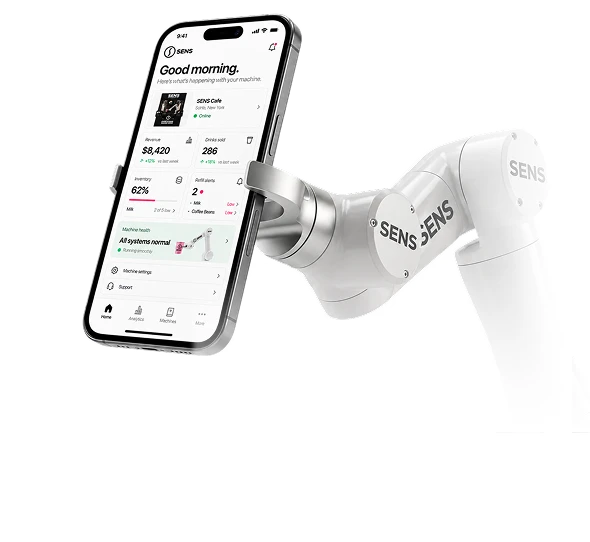
SENS describes remote visibility into revenue, inventory, refill alerts and machine status. The operational question is what happens after an alert appears.
For each alert category, specify the recipient, the expected response, a backup contact and how the issue is closed. Distinguish a supply reminder from a condition that requires a drink or the unit to remain unavailable pending assessment. Confirm which actions can be taken remotely and which require a visit.
Review service interruptions as well as sales. Repeated incidents at the same time of day may point to an unsuitable refill schedule, limited site access or an unresolved equipment issue. The dashboard supports that review; it does not replace physical inspections or service work.
Plan maintenance and guest support
Schedule preventive work according to the manufacturer’s requirements, equipment use and service agreement. Clarify warranty coverage, technician availability, replacement-part arrangements and responsibility for costs before a fault occurs.
Guests also need a visible way to report an interrupted order or payment problem. Define who checks the transaction, communicates with the guest and handles the applicable resolution. Feed recurring complaints back into the operating review so the same problem is not repeatedly treated as an isolated incident.
Budget for the work behind the automation
Include replenishment, cleaning, transport, supplies, maintenance and management in the location’s operating plan. Automation can reduce the need for a dedicated barista at each transaction; it does not make the business free of operating labor or costs.
Use the cost and operating plan guide to compare equipment, launch and recurring expenses on a consistent basis.
Choose the operating model that fits your involvement
Share your target city, proposed venue and preferred level of involvement with SENS. Ask for a written scope explaining the equipment, daily responsibilities, support and reporting for your location.